
Over the last few days, the team has been running internal testing across wallets within the Tratok Ecosystem, focused on two things: the operational effectiveness of the new dual-chain wallet functionality, and the integrity of how the Ecosystem’s booking flow interacts with each underlying blockchains. We wanted real data on speed, cost, and reliability before this infrastructure carries a single dollar of real user activity at scale.
The results are in, and they are better than what we forecast, not marginally, but by a meaningful margin. Here is what the data showed.
What the testing measured
Each test transaction was run through the Ecosystem’s booking and transfer logic, settling on-chain via either the Ethereum network or the BNB Smart Chain, with completion time and transaction cost recorded for every instance. The goal was statistically meaningful data, not a handful of sample runs, enough volume to trust the averages.
- Median cost of $0.012 per transaction
- Consistent settlement across thousands of test instances
- Fully usable, but the slower of the two networks
- Median cost of $0.004 per transaction
- Roughly a third of the ETH cost, near-instant settlement
- The network the Ecosystem now settles bookings on
Both networks performed within usable ranges. BSC in particular settled almost instantly, with a median cost roughly a third of the ETH figure. But the number that genuinely surprised the team during analysis was how these costs compared to what we had originally modelled for this stage of the Ecosystem’s growth.
The cost per transaction we are seeing in real testing is roughly 1/240th of what we had built into our forecasts. That is not a rounding difference, it is the kind of gap that changes how confidently we can scale this infrastructure. Costs can move over time as network conditions shift, and we are not assuming today’s figures are permanent. But even allowing for that, we do not see cost as a constraint on this system going forward. The constraint we actually care about, and the one this testing was really designed to settle, is time. A booking platform lives or dies on how fast a transaction confirms, and on that measure, the data gives us real confidence.
Why we’re simplifying what you see
This same round of testing happened alongside professional user acceptance testing (UAT) feedback on the dashboard update pushed over the last few days. The candid version of that feedback: the latest enhancements made the user-facing wallet view more complicated than it needed to be. We listened, and we agree. So we are implementing their suggestions to make things more user friendly.
Here is the principle behind the change. A Tratok token is a Tratok token, regardless of which blockchain happens to be powering it underneath. The deposit address tied to your Ecosystem account is identical whether you send TRAT in via the ETH network or the BSC network. One address with absolutely no difference to you when depositing. Given that, surfacing granular chain-by-chain detail on every screen was adding visual noise without adding any real decision for the user to make.
That last point is the one exception, and it is an important one. The only moment a user actually needs to see and choose between ETH and BSC is when withdrawing TRAT out to a personal wallet. That is where chain choice is a real decision with real consequences as you may simply have a preference and we want to keep the freedom and flexibility in the hands of Tratokians. Everywhere else in the Ecosystem, the chain underneath is implementation detail, not something you should have to think about.
How a booking actually settles
There is one more decision worth explaining directly, because the testing data made it an easy call. While the cost difference between ETH and BSC is not material and we expect economies of scale to make it even less so as activity grows, the difference in processing time is significant, and processing time is the variable that shapes how a booking actually feels to use.
A booking confirmation that takes one to three seconds reads as instant. A confirmation that can stretch toward forty seconds does not, even though both are perfectly normal blockchain settlement times. Given that gap, and given that the user never needs to see which chain is doing the work, the decision was straightforward: the Ecosystem will settle all bookings on the BSC network, regardless of which chain the user originally deposited on. You get the fastest available experience by default, with zero action required on your part.
The diagram below shows how this fits together end to end: how a deposit on either chain lands in one unified balance, how that balance is used for bookings, and where chain choice reappears for withdrawals.
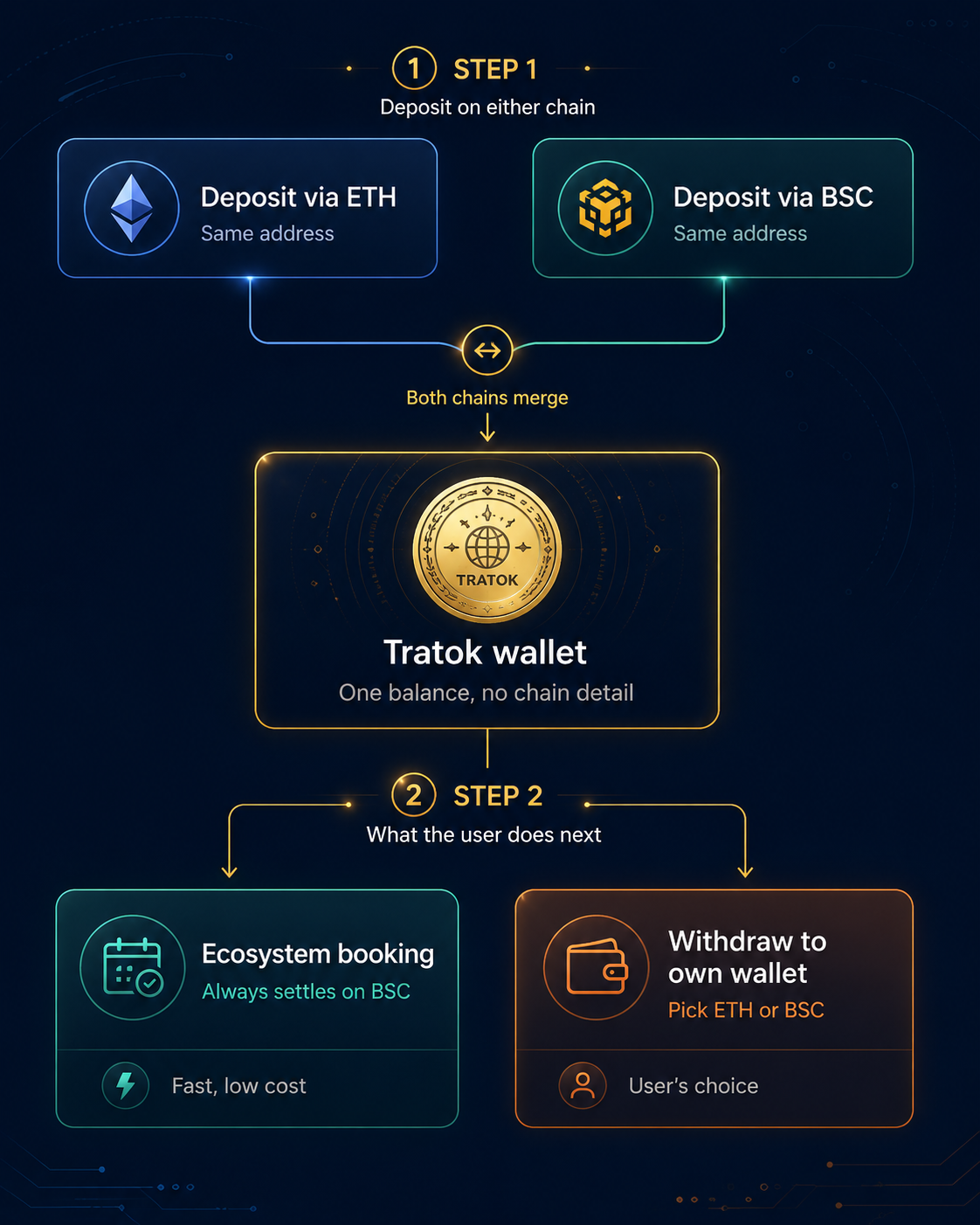
Deposit on whichever chain is convenient for you, see one simple balance, book instantly through BSC behind the scenes, and choose your chain only when you withdraw to your own wallet. Three moving parts, one of which you ever need to think about.
A note: this post is an operational update from the Tratok community team and represents the author’s perspective on current platform and infrastructure activity. It is not investment advice. TRAT and all digital assets carry significant risk and can lose value. Transaction times and costs cited reflect internal testing conditions at time of writing and may vary with network conditions; they are not a guarantee of future performance. Always conduct your own research.
Carol
Community Manager, Tratok
Never miss an update
Get new Tratok articles by email: the moment they publish, or as one weekly digest.